

Scientific Computing
Centrum Wiskunde & Informatica

The Scientific Computing group at CWI develops efficient mathematical methods to simulate and predict real-world phenomena with inherent uncertainties. Our two main research themes are scientific machine learning and uncertainty quantification, and the topics within these themes are neural ODEs, closure models for turbulence, reduced-order models, discretization techniques, stochastic parameterizations, generative models, data assimilation.
Our official CWI page with general information can be found here. On the current page, you can find more detailed information such as the software that we develop in the group and other useful information such as the material used in the semester programmes that we organize, in particular the SciML and UQ semester programmes. Note the recent semester programme 2025 on Synergies in numerical linear algebra and machine learning!
Please check our GitHub page with group repositories and our software page.
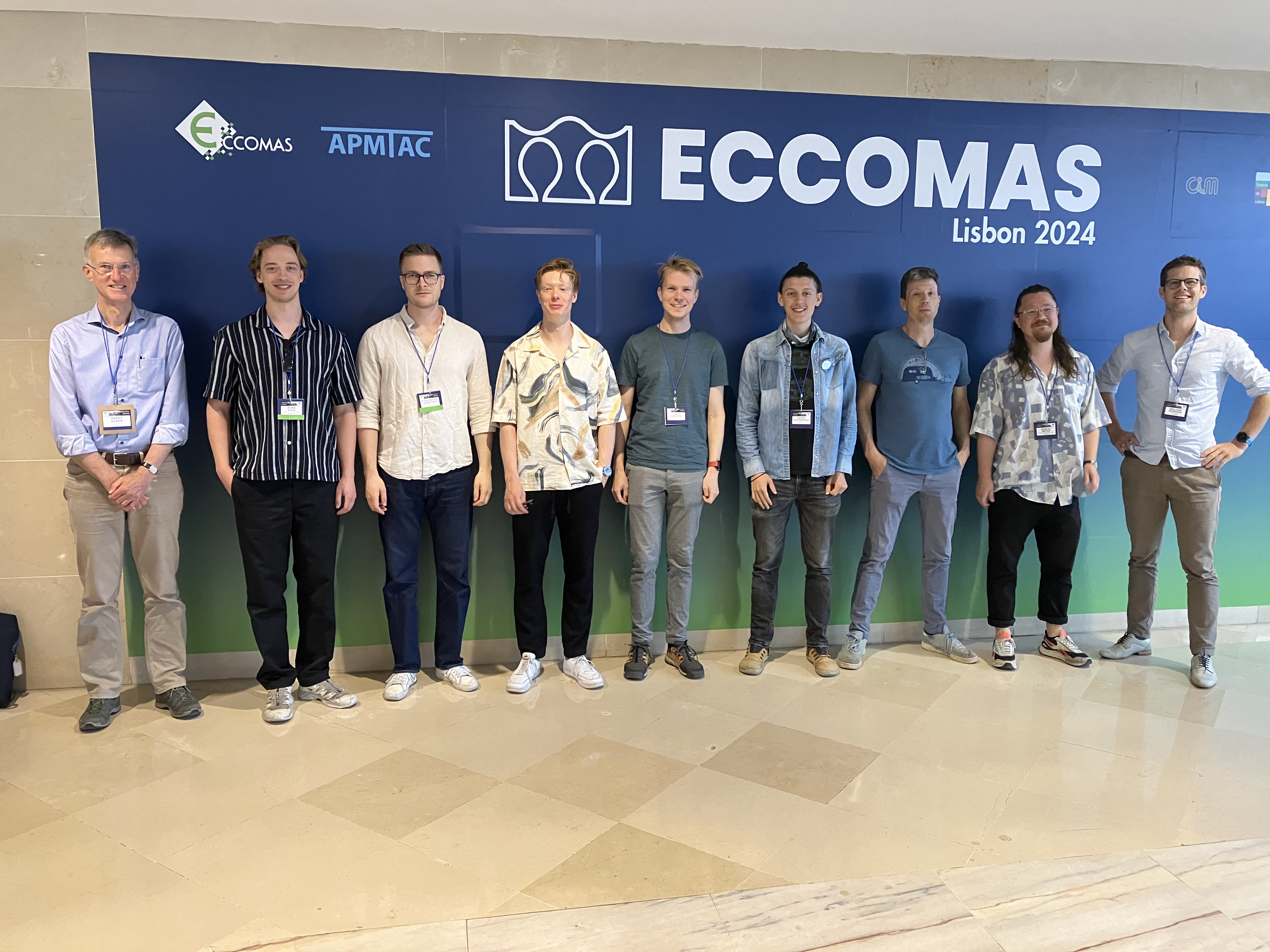
The group currently has 14 members. See the members page for everyone's role and links.
Our group is regularly involved in group challenges, in which we, as a group, tackle an outstanding societal challenge that is given to us by a research institute or industry. These are short-term projects, typically 3-6 months in duration, on which we work in a team of approximately 5 people on Friday afternoons. We add value through our extensive knowledge of scientific computing, uncertainty quantification and scientific machine learning, and our strong programming skills in modern languages such as Python and Julia. Over the last year, we worked with Deltares on predicting failure probabilities of Dutch dikes, and with KNMI on the fine-grained temperature prediction in Europe using Gaussian process regression.
See all recent publications, or the full list in CWI's institutional repository.